 Eulerv2
 vaults: deposits as Euler V2 collateral
Euler V2 organizes lending around vaults for individual assets. Deposits can secure borrowing from another vault where it accepts them as collateral and the account meets its requirements.
- Vault framework
- The Euler Vault Kit (EVK) creates and manages lending vaults for individual ERC20 assets.
- Deposit accounting
- Suppliers receive ERC-4626 shares that represent deposits in a vault holding a specific underlying asset.
- Cross-vault coordination
- The Ethereum Vault Connector (EVC) coordinates actions between vaults, including the use of accepted deposits as collateral.
What the shares represent
The underlying asset enters the vault, while ERC-4626 shares record the supplier's position in that vault. For borrowable lending vaults, borrower interest and utilization affect supplier returns alongside configured fees and vault accounting.
A share position does not guarantee immediate access to its underlying assets. Withdrawals depend on available vault liquidity and contract limits.
How deposits become eligible collateral
The EVC supports collateral relationships between vaults, allowing a borrowing vault to recognize deposits in another vault. The borrowing vault selects which deposits it accepts; ERC-4626 shares alone do not establish that acceptance.
Deposits in a non-borrowable vault may secure loans from connected vaults that accept them. Borrowing from the non-borrowable vault itself is unavailable.
How the borrowing vault enforces its rules
Borrowing through the EVC requires accepted collateral enabled in the account and a designated liability controller. The controller can be the borrowing vault or another contract.
That controller has authority over the account's enabled collateral within the EVC. It can prevent collateral withdrawals and seize collateral during liquidation.
The vault providing the loan, known as the liability vault, values collateral and debt through its configured oracle route. It enforces borrowing and liquidation loan-to-value (LTV) thresholds, caps, and account checks. An account can become eligible for liquidation if it no longer satisfies that vault's collateral requirements.
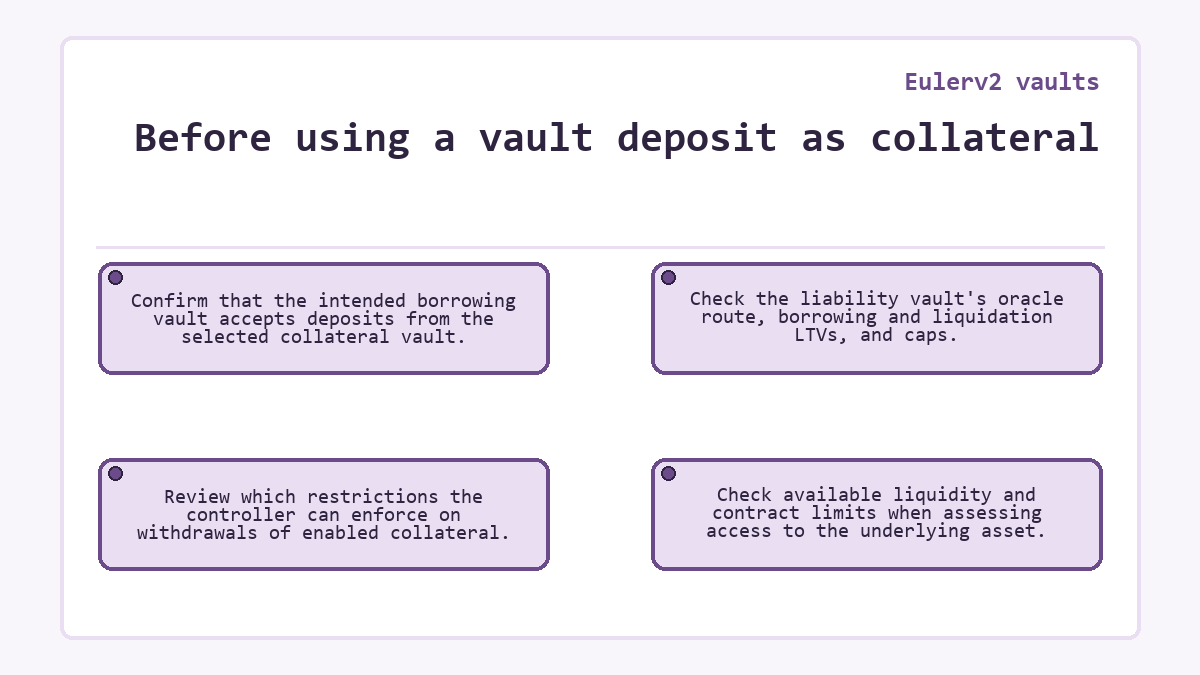
Before using a vault deposit as collateral
- Confirm that the intended borrowing vault accepts deposits from the selected collateral vault.
- Check the liability vault's oracle route, borrowing and liquidation LTVs, and caps.
- Review which restrictions the controller can enforce on withdrawals of enabled collateral.
- Check available liquidity and contract limits when assessing access to the underlying asset.
Updated